Unifying content across Home, Protect, & Family
A systems-led cross functional content audit
Challenge
Customers were navigating three Verizon apps—Home, Protect, and Family—that were designed and written by different product teams. Over time, the experiences drifted apart: the same actions had different names, flows varied despite solving the same problem, and error states lacked consistency or recovery paths. This fragmentation increased cognitive load, made cross-app journeys confusing, and slowed development for teams working on interconnected features.
My Role
I conducted a multi-layered review across Verizon Protect, Home, and Family, mapped terminology and patterns, and identified where inconsistent content was creating user friction. I partnered closely with Product, Design, Engineering, Research, and Support teams to validate findings, align on terminology, and define a scalable model for unified content across the ecosystem.
Process
I approached the audit in 3 structured phases to ensure depth, breadth, and cross-team alignment.
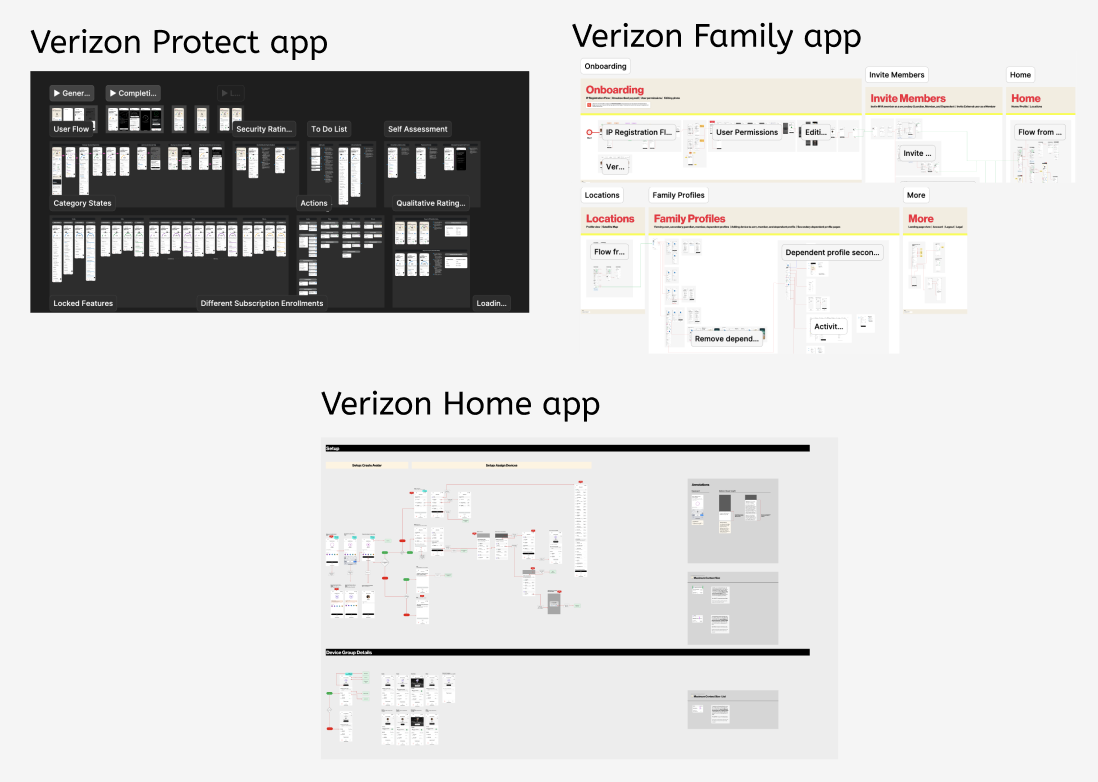
Phase 1: Content audit: Reviewed content across all 3 apps, including—
Navigation & IA
Onboarding
Core user flows
Notifications (push + in-app)
Settings & account
Error, empty, and success states
Legal/compliance-driven content
→ Goal: Build a complete view of the ecosystem.
Phase 2: Evaluation, Pattern Analysis & Terminology Alignment
Evaluated content quality across key UX writing heuristics, including clarity, cognitive load, consistency, accessibility, tone, and recovery guidance.
Assessed content across clarity, cognitive load, consistency, accessibility, tone, and recovery to identify friction points.
Reviewed patterns across CTAs, instructions, system states, flows, naming, and notifications to surface inconsistencies and redundancies.
Analyzed terminology drift and internal language that created user confusion across apps.
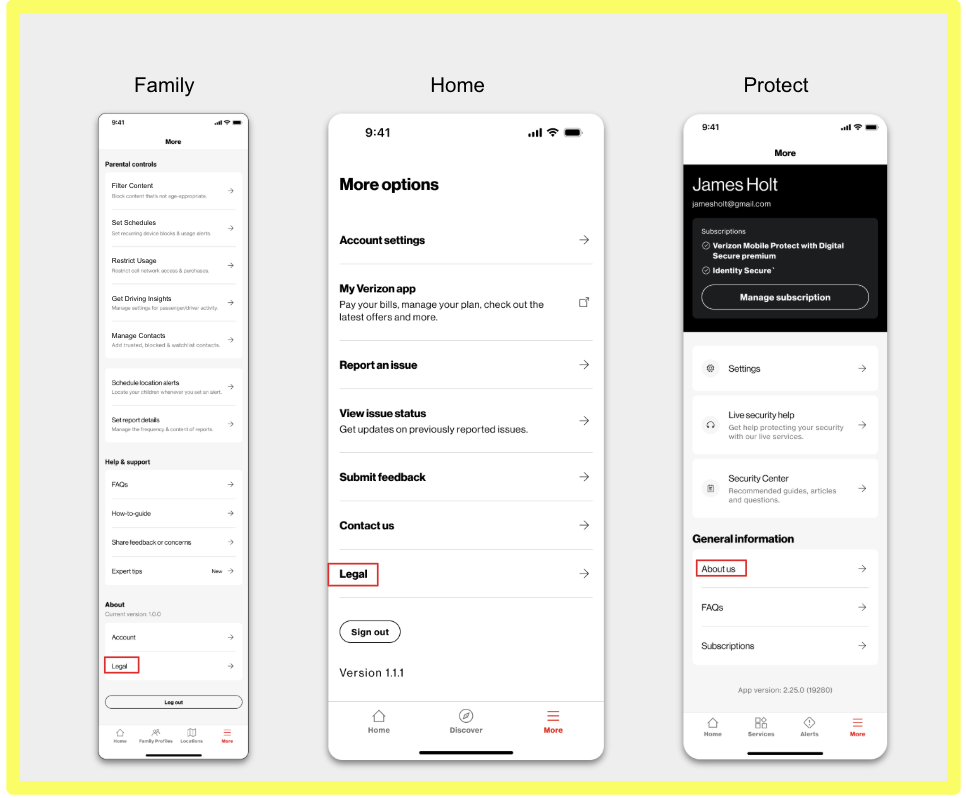
Example: Each app functionally used the same "More" screen, but nomenclature and content hierarchy wasn't aligned.Phase 3: Cross-Functional Validation & Alignment
I led working sessions with stakeholders from Product, UX Design, Research, Engineering and Legal/Compliance.
These sessions helped me confirm findings, clarify system constraints, and build shared ownership between the teams
→ Goal: Ensure the audit was not just accurate, but actionable.
Result
Synthesized insights into two foundational deliverables:
A cross-app content guide defining unified terms, tone, and reusable patterns.
Recommendations for alignment outlining system-level fixes and opportunities for future consistency.
Outcome
Mapped fragmentation across the ecosystem—surfaced terminology inconsistencies, pattern drift, and duplicate flows that were slowing teams down.
Delivered two key artifacts: a cross-app Content Guide (unifying language, tone, and reusable patterns) and a Recommendations for Alignment document outlining system-level improvements for consistency and scalability.
Enabled cross-functional alignment—giving Product, Design, Engineering, and Legal a shared foundation that reduced redundancy, simplified naming decisions, and helped move the organization toward a more unified ecosystem.
Reflection
This project revealed that content is the connective tissue of product ecosystems.
What I’m most proud of:
I reframed a content problem as an ecosystem problem.
I led teams toward shared understanding, not just shared documentation.
I created space for alignment where siloed work had created drift.
I delivered a framework that future-proofed decision-making.
Ultimately, this audit wasn’t about correcting words—
it was about designing language systems that make complex products feel intuitive, cohesive, and trustworthy.
It highlighted the power of content design as systems leadership, and the impact a unified language can have on the user experience, team velocity, and product cohesion.